
Last updated November 2, 2026
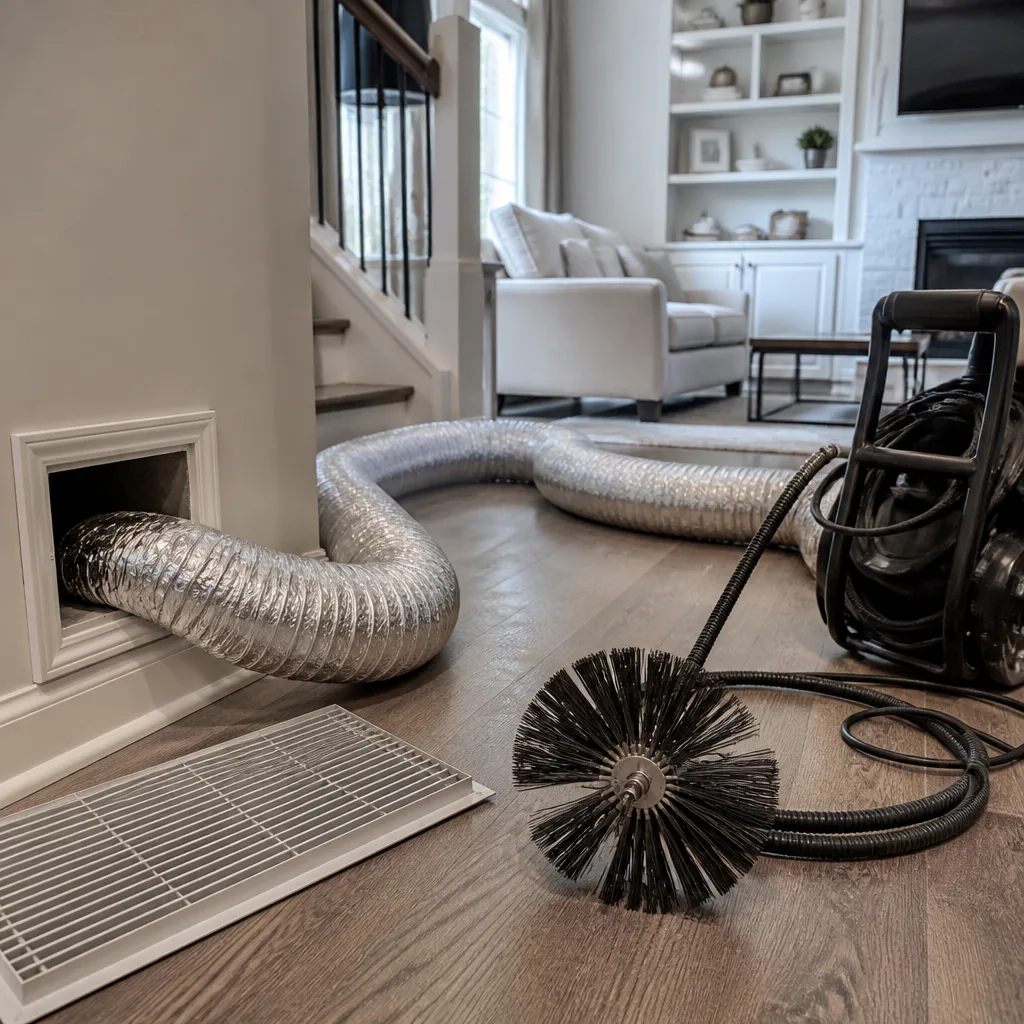 Whole-home duct cleaning
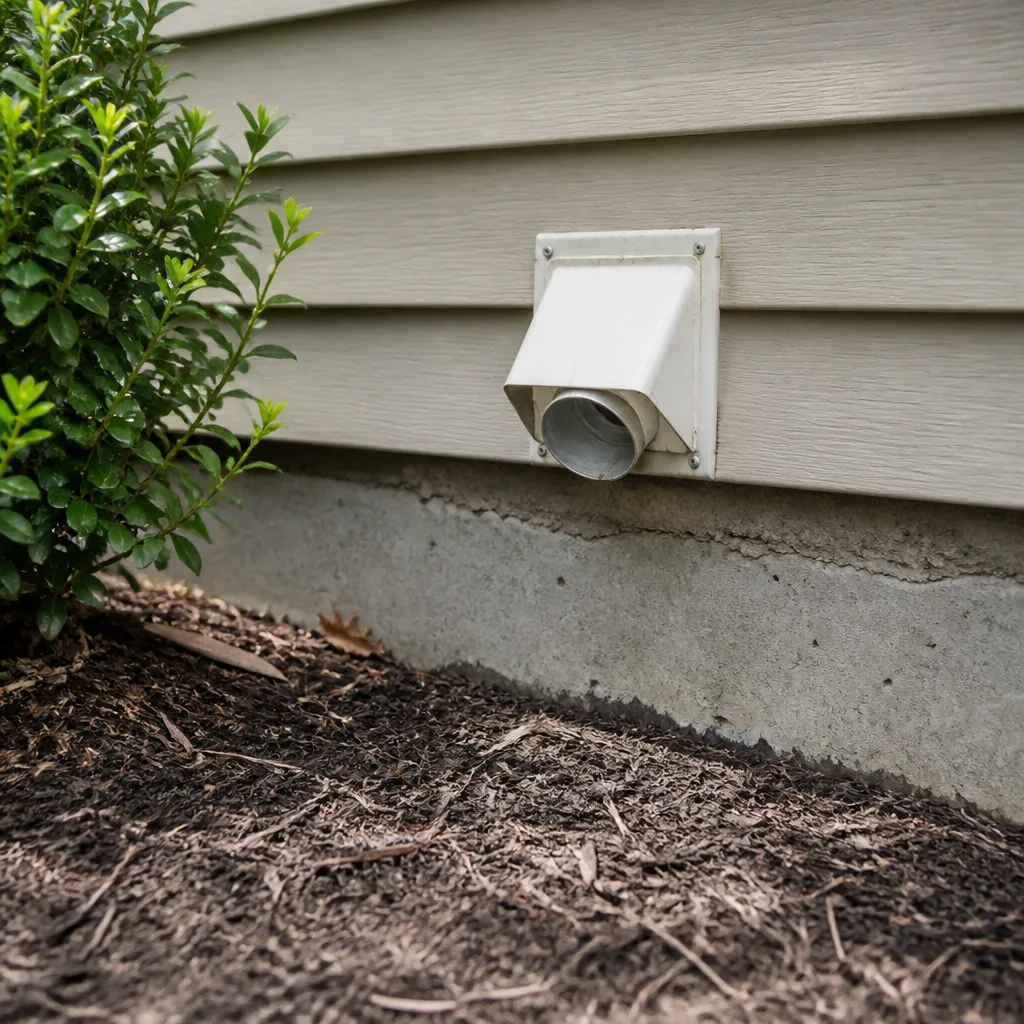 Dryer vent cleaning
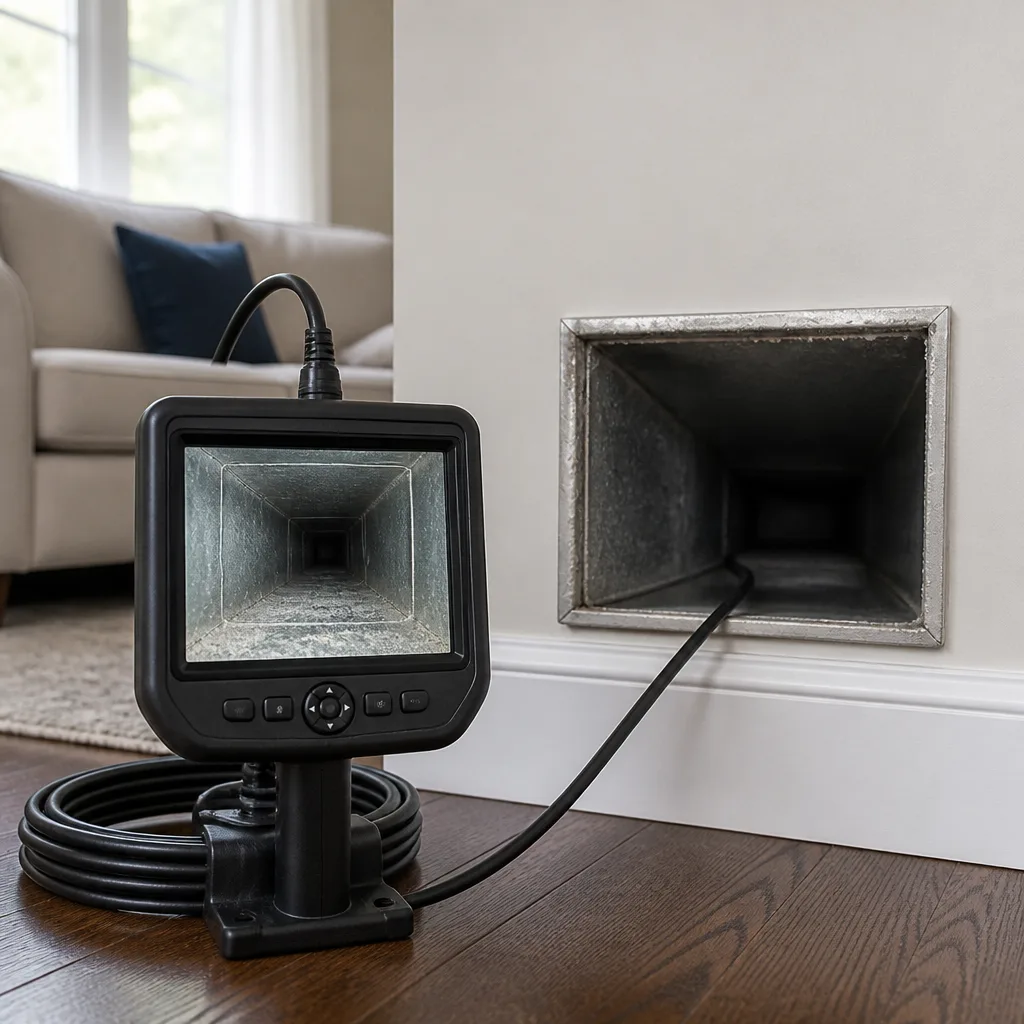 Camera inspection
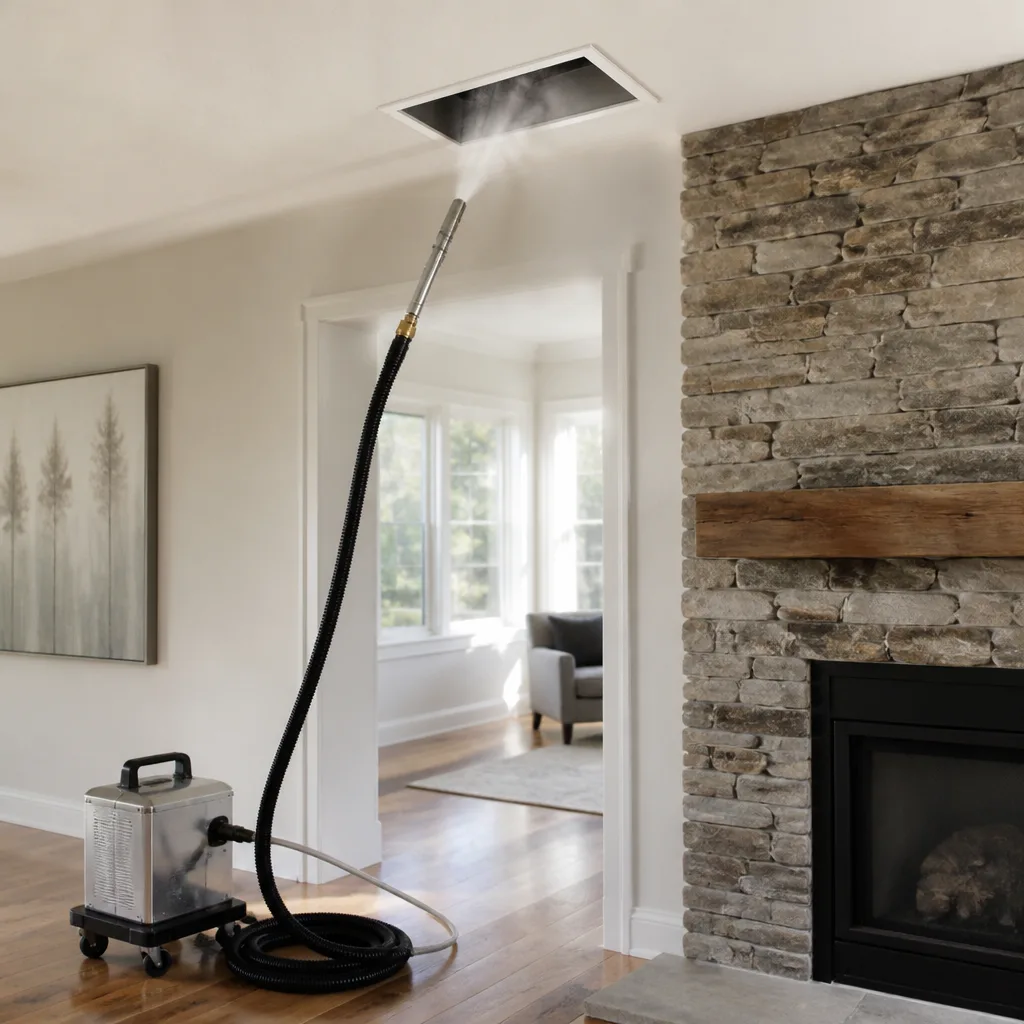 Sanitizing & deodorizing
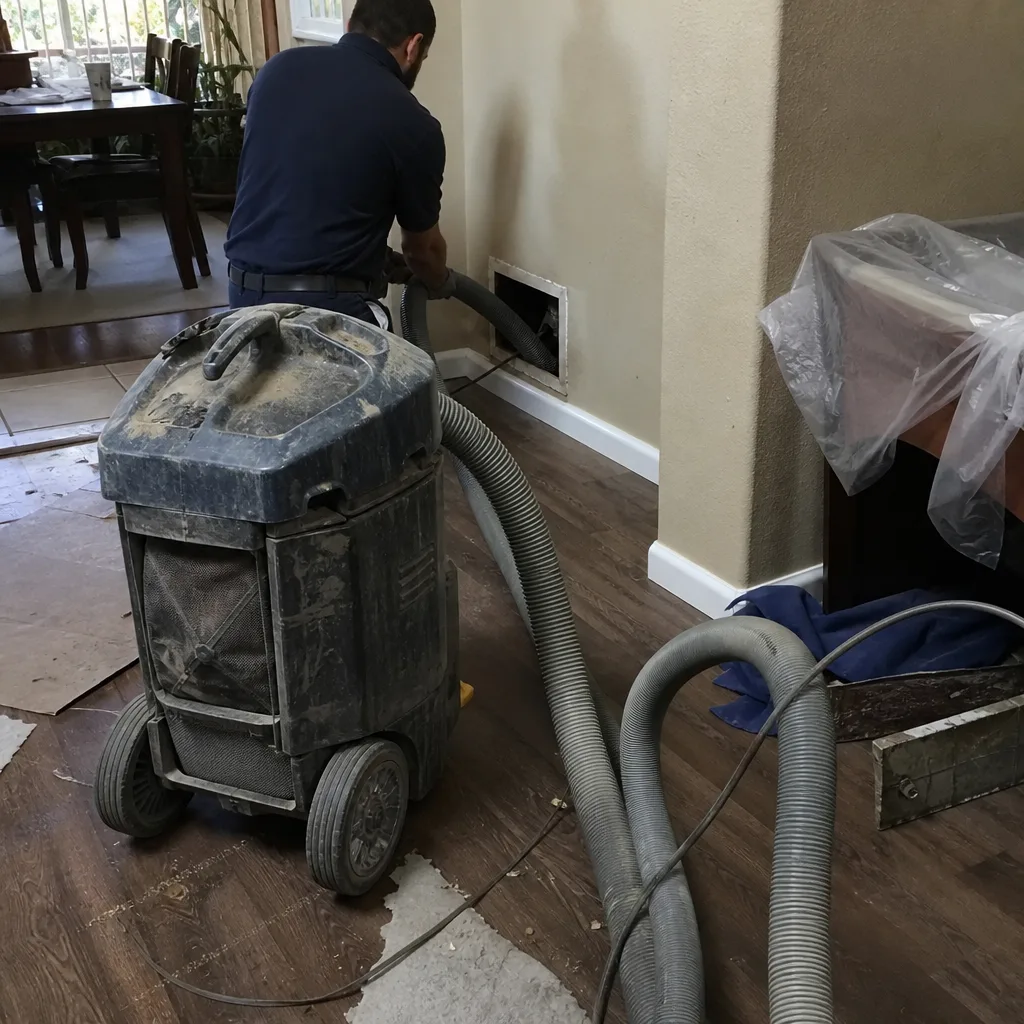
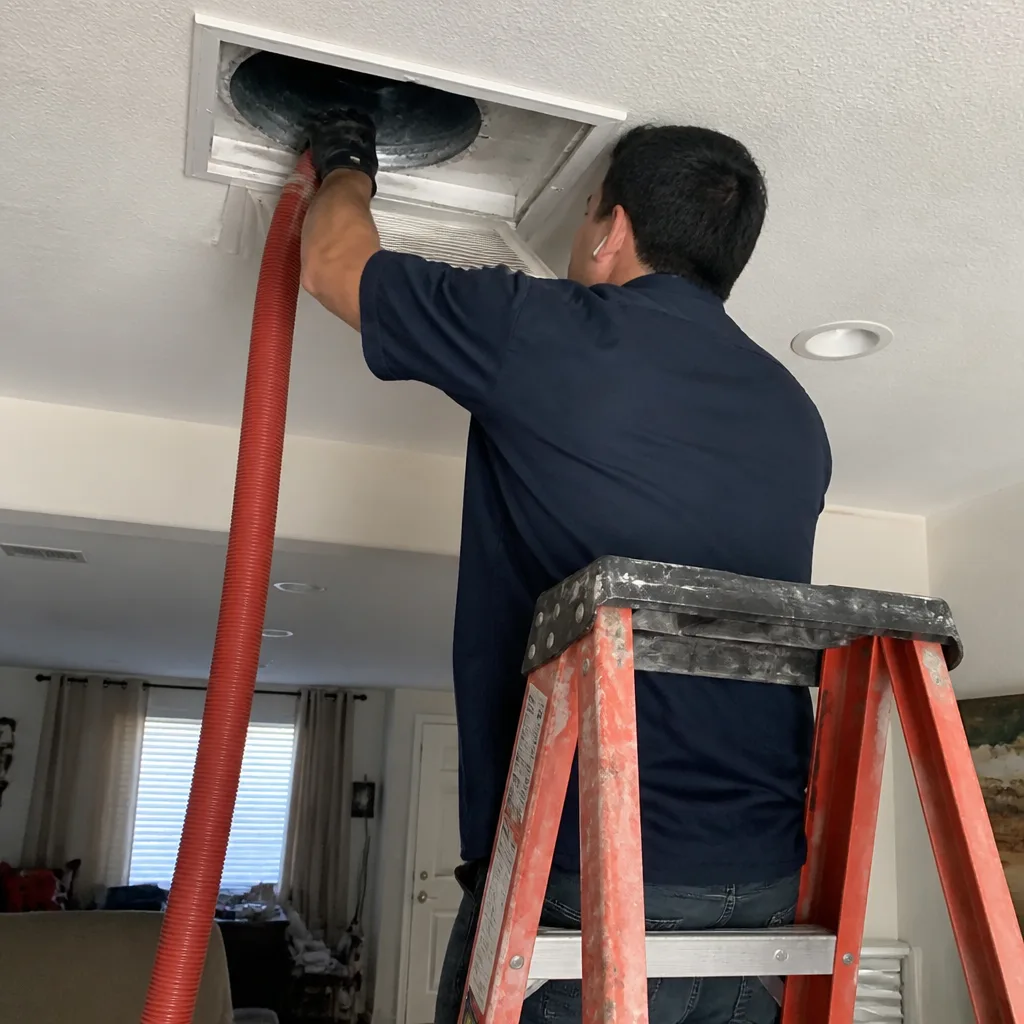
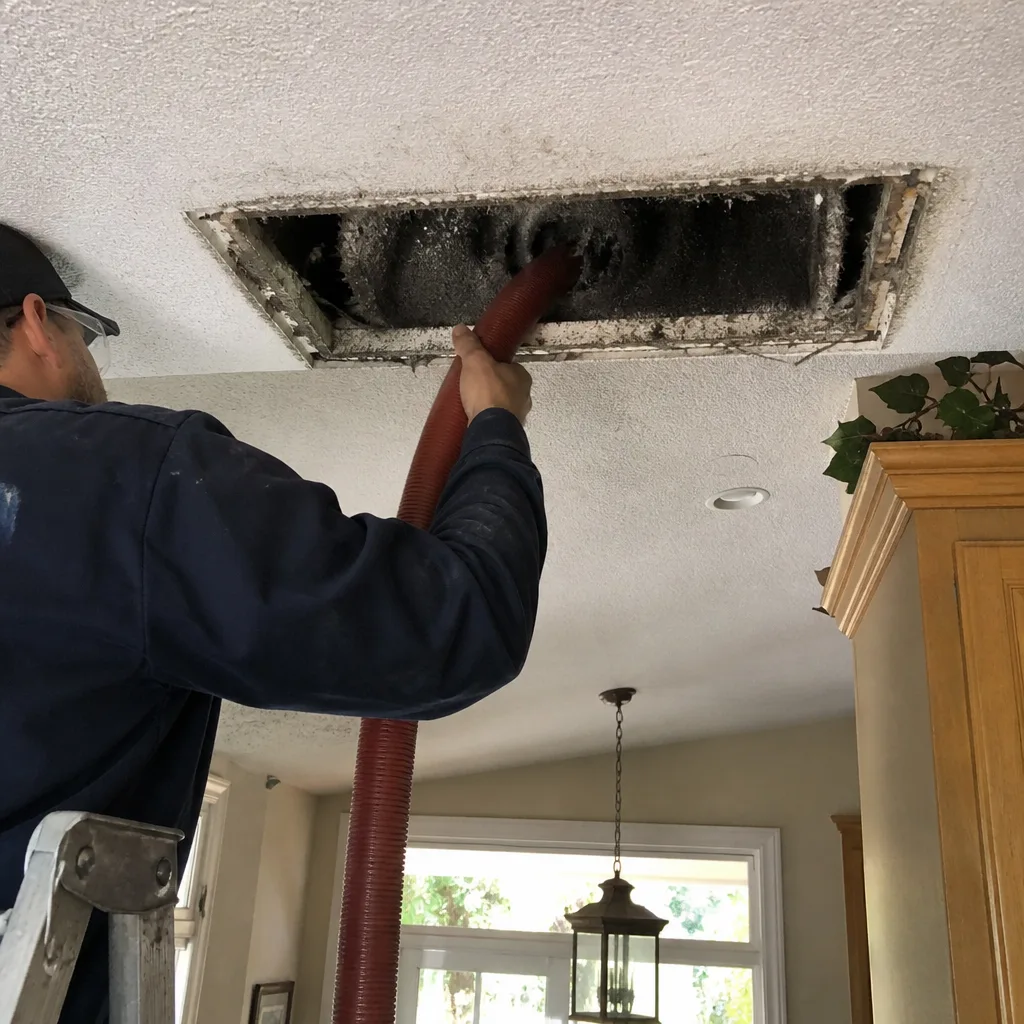
Whole-system duct and dryer vent check with before-and-after photos - you see exactly what came out of your vents
That "$99 whole-house special" is a bait ad - the real number appears once they are in your hallway, or the "clean" is a shop-vac at the register. We photograph the inside of your ducts before and after instead.
Air Duct Cleaning Emergency Preparedness Guide for Chula Vista Homes
In Chula Vista, we don’t think about our ductwork until something goes wrong. And by then, the problem has usually been circulating through every room for days. What most homeowners don’t realize is that the duct system in a typical Chula Vista home holds between 5 and 15 pounds of accumulated dust, pet dander, construction debris, and biological material, all of it sitting in the dark spaces behind your walls. After a wildfire smoke event, a flood, or even a moderate earthquake, that material doesn’t just sit there. It gets disturbed, resuspended, and pushed through your vents. This guide walks through exactly what to check in your Chula Vista home after each type of emergency, what order to do it in, and when the situation calls for a contractor with restoration-level equipment rather than a basic Air Duct Cleaning service.
Quick Answer
Air duct cleaning after an emergency in Chula Vista depends on the type of event. After wildfire smoke, you should inspect your filter, check for visible soot around supply registers, and consider a professional coil and duct inspection before running your HVAC normally. After flooding or water intrusion, the priority is determining whether ductwork in affected areas got wet, because mold can establish in duct lining within 48 to 72 hours. After an earthquake, the main risks are disconnected duct sections, crushed flex duct, and gaps at connection points that pull attic air or crawlspace air into your system. In all three cases, the sequence is: shut the system off, do a visual assessment, and call a contractor who can inspect the full air pathway rather than just vacuuming the registers.
Styles & brands we work with
- Whole-home duct cleaning
- Dryer vent cleaning
- Camera inspection
- Sanitizing & deodorizing
Table of Contents
- The Wildfire Smoke Protocol for Chula Vista HVAC Systems
- Post-Flood and Water Intrusion: Ductwork and the 48 to 72 Hour Mold Window
- Post-Earthquake Ductwork Inspection Checklist for Chula Vista Homes
- Pre-Emergency Preparation: Setting Up Your Air System Before Something Happens
- Temporary Measures During an Active Air Quality Emergency
- What Professional-Grade Duct Cleaning Equipment Actually Does
- Common Mistakes to Avoid
- When to Call a Professional
- Frequently Asked Questions
Key Takeaways
- After any environmental emergency in Chula Vista, shut your HVAC system off before doing anything else. Running it stirs whatever entered the ducts and pushes it through the house.
- Wildfire smoke leaves fine particulate that household filters do not catch. A visual coil inspection matters more than a filter swap.
- Wet ductwork has a 48 to 72 hour window before mold establishes. The clock starts the moment water contacts the duct interior.
- Earthquake damage to ducts is usually at connection points and flex duct transitions, not in the middle of straight runs. These are also the places a basic cleaning will miss.
- Your filter only protects the equipment, not the ductwork downstream. Duct interiors accumulate material regardless of filter quality.
The Wildfire Smoke Protocol for Chula Vista HVAC Systems
Chula Vista sits downwind of major wildfire corridors in East County and, depending on the season, can receive measurable smoke intrusion from fires as far north as the Sierra foothills or as close as Otay Mountain. Smoke is not just an outdoor problem. The fine particulate in wildfire smoke, what air quality agencies call PM2.5, measures less than 2.5 microns across. A standard one-inch fiberglass filter, the kind in most Chula Vista homes, catches particles larger than 10 microns with any reliability. That means the bulk of wildfire smoke particulate passes straight through the filter, across the evaporator coil, and into the supply ducts. Some of it settles. Some of it stays airborne. All of it waits.
Here is what we tell homeowners in Chula Vista to do after a significant smoke event, and the order matters:
- Turn the HVAC fan to “off” at the thermostat, not just “auto.” The auto setting still runs the blower for air circulation even when the system is not heating or cooling. You want the air in the ducts to settle, not stir.
- Inspect the filter without removing it roughly. Slide it out slowly. If it is dark gray or brown rather than its normal color, that tells you smoke particulate loaded the filter. But even a clean-looking filter does not mean the system is fine. Smoke bypasses filters by design.
- Look at the supply registers in each room. Use a flashlight. Soot from wildfire smoke is typically gray to black and will show as a fine dusting on register grilles, especially in rooms farthest from the air handler. If you see it on the grille, it is in the duct.
- Check the return air grille and the area around it. Return grilles pull room air in. If smoke was in the house, the return side of the system pulled it in too. Look for a gray film on the grille and on the wall above it.
- Do not run the system “just to see if it smells.” That smell is the answer. Running the system after smoke intrusion redistributes settled particulate off the coil and out of the supply registers into living areas.
What we have seen in Chula Vista homes after heavy smoke seasons is a predictable pattern. The homeowner changes the filter, the house still smells like smoke for weeks, and the actual source is the evaporator coil and the first few feet of supply duct, where the smoke particulate settled into the condensation film on the coil and adhered. A filter change does not touch it. A coil cleaning does. This is the difference between addressing the symptom and addressing the deposit point. If you are uncertain whether your system needs a coil inspection, air duct cleaning in Chula Vista that includes coil inspection is the relevant service. Not all cleaning companies include it. Ask before you book.
For homes using Honeywell or Aprilaire media filters with higher MERV ratings, the calculus changes slightly. A MERV 11 or MERV 13 media filter will catch a meaningful portion of wildfire smoke particulate, but the filter loads fast during a smoke event. A loaded media filter restricts airflow, which drops system efficiency and can cause the coil to freeze in summer. After a smoke event, replace the filter even if it does not look fully loaded. The pressure drop across a smoke-loaded media filter is higher than its appearance suggests. If you run a Honeywell whole-house filter or an Aprilaire media cabinet, you already have better smoke protection than a standard one-inch filter, but the duct system downstream of the filter is still unprotected during any period when the filter was saturated or when the system ran with doors or windows open during the event.
Post-Flood and Water Intrusion: Ductwork and the 48 to 72 Hour Mold Window
Chula Vista sees flooding in predictable patterns. Winter storm systems push water through the canyons and low-lying areas west of the 805. Older homes in neighborhoods like Castle Park and some parts of the west side have crawlspaces or ground-level utility closets where ductwork runs through areas that see standing water. When water gets into a crawlspace, it does not need to touch the ductwork directly to create a problem. Elevated humidity in a flooded crawlspace condenses on the exterior of sheet metal ducts, and if the duct insulation is fiberglass with a vapor-facing barrier that has degraded, moisture wicks through. Inside the duct, the environment becomes humid enough to support microbial growth on accumulated dust and debris.
The 48 to 72 hour window is not a suggestion. It is the established timeline for mold germination on wet organic material in indoor environments. Dust inside ductwork is mostly organic: skin cells, pet dander, pollen, insect fragments. Add moisture, keep the temperature between 65 and 85 degrees, which is exactly what a Chula Vista crawlspace or attic holds most of the year, and you have ideal conditions. Here is what to look for after a water event:
- Identify where your ductwork runs. If you do not know, go look. Attic installations are visible. Crawlspace installations require a flashlight and some stooping. The point is to know which parts of the system were near water.
- Look for standing water or mud lines in the crawlspace or under the house. A mud line on the foundation or on piers tells you how high the water reached. If ductwork is within six inches of that line, assume it got humid at minimum, and possibly wet.
- Check duct insulation at low points. Water that contacts the exterior of an insulated flex duct will wick upward through the insulation. The duct exterior will feel damp, look darker, or show water staining at the lowest point of the run.
- Smell the supply registers. After a flood, a musty or earthy smell from the registers during system operation indicates water contact somewhere in the duct path. This is not a smell that goes away with a filter change.
- Look at the flex duct connections at the plenum and at boots. Water in a crawlspace often enters the system at the low connection points, not through the middle of a duct run. Pull the grille off a floor register and look down. If you see staining, debris, or visible dampness at the boot, the duct connected to it needs inspection.
The honest truth is that wet duct insulation usually cannot be dried in place. Fiberglass duct insulation that has absorbed water holds moisture against the duct wall, and the interior surface provides the substrate for mold growth. In most cases, the right fix is replacing the affected duct sections, not cleaning them. That is where the repair side of our scope matters. Air duct repair in Chula Vista for water-damaged sections typically involves removing the affected flex duct, replacing it, resealing the connections, and then cleaning the remainder of the system to remove any material that was introduced. If the damage is isolated to one branch run, replacing that run is often cheaper than a full system cleaning and is the only fix that removes the contaminated material entirely. We repair what others only clean around, and in a water-damage situation, cleaning around it is not enough.
The proactive move for Chula Vista homeowners is knowing whether your ducts run through a crawlspace, an attic, or both. Attic installations are less exposed to flooding but more exposed to heat and to damage from roof leaks. Crawlspace installations are more exposed to water events and to rodent intrusion. If you live in an older Chula Vista home with a crawlspace, make a point of looking under the house once a season. The time to find out your ducts run six inches above the crawlspace floor is not the day after a flood.
Post-Earthquake Ductwork Inspection Checklist for Chula Vista Homes
Chula Vista sits less than 10 miles from the Rose Canyon fault zone, and residents feel earthquakes that originate well south of the border as well. Most earthquake damage to residential ductwork is not dramatic. A duct does not need to collapse to cause a problem. It needs to separate at a connection, sag in the middle of a run, or get pinched where it passes through framing. Any of those creates a gap or restriction that changes system pressure, and the practical result is that your HVAC system starts pulling attic air or crawlspace air into the house, or pushing conditioned air into unconditioned space instead of into rooms.
After an earthquake that you can feel, here is what to check before running the system:
- Listen at startup. Turn the system on at the thermostat and walk the house. A new whistling, hissing, or flapping sound from a register often indicates a disconnected or crushed duct. Air escaping a disconnected joint makes a distinct sound.
- Check the registers for airflow changes. If one room suddenly gets weak airflow while another gets stronger, the most likely explanation is a separated duct on the strong airflow branch. The air takes the path of least resistance. A duct that separates from the plenum turns the system from a network into a leak.
- Look at the flex duct where it connects to the plenum. The plenum is the metal box attached to the air handler. Flex duct connects to it with a metal collar and a zip tie or clamp. These connections are the weak points in any residential system, and the first to fail under shaking. From the attic or crawlspace, inspect the collar. If the flex duct has pulled away or the collar is loose, the system is pulling unconditioned air from the space around the connection.
- Check flex duct runs for sagging or kinking. Flex duct is suspended from framing with straps, usually every four to six feet. Earthquake movement can cause a strap to let go, allowing the duct to sag. A sag that creates a kink reduces airflow to that branch. If the duct is resting on the attic floor or on a crawlspace joist, it needs to be re-strapped and possibly replaced.
- Look at duct boots, which are the metal or plastic fittings that connect the duct to the floor or wall register. A moderate earthquake can loosen a boot from the subfloor, especially in older Chula Vista homes with original registers and sheet metal that has been in place for decades. A loose boot leaks conditioned air into the floor cavity or wall space rather than into the room.
None of these checks require opening walls, and none of them require specialized tools. They require a flashlight, patience, and access to the attic or crawlspace. What we have found in Chula Vista homes after seismic events is that the damage is rarely in the middle of a straight duct run. It is at the connections, the transitions, the boots, and the suspended sections. That matters because these are also the places a discount cleaning company never looks. A cleaning truck that shows up, hooks a vacuum to one register, and works for 45 minutes will not notice a separated duct at the plenum. The system will still be leaking. The house will still be uncomfortable. The homeowner will have paid for a service that did not address the actual problem.
This is where the full air pathway approach earns its place. If you are in Chula Vista and have felt an earthquake, the smart sequence is: do the visual check described above, then call a company that offers air duct repair in Chula Vista and cleaning as connected services, not as isolated jobs. A separated duct needs to be reconnected before the system is cleaned. Cleaning a system with a disconnected branch just means you are vacuuming attic air through the blower.
Pre-Emergency Preparation: Setting Up Your Air System Before Something Happens
The best time to prepare your HVAC system for an emergency in Chula Vista is a Tuesday in April, when the sky is clear and nothing is on fire, flooding, or shaking. The preparation is simple, does not require professional help, and takes less than an hour. For Air Duct Cleaning Maintenance Checklist for Chula Vista Homeowners and more guides & resources, see our blog. Here is what we recommend for every Chula Vista homeowner:
- Know where your air handler shutoff is. Every residential HVAC system has a disconnect switch, usually a metal box mounted on the wall near the air handler or a breaker labeled “air handler” or “furnace” in the electrical panel. In an emergency, you want to cut power to the blower quickly. Not the thermostat. The equipment. Find it now, before you need it in the dark.
- Change filters on a schedule, not on a smell test. In Chula Vista’s climate, a standard one-inch filter should be changed every 60 to 90 days. Homes with pets, homes near freeways, and homes in canyons or foothill areas that get seasonal dust should change more often. A dirty filter going into fire season means you are starting behind. If your filter has been in place for six months and a smoke event hits, the filter is already saturated with ordinary household dust. Its smoke-holding capacity is effectively zero.
- Document your duct configuration. Take photos of your attic and crawlspace ductwork in good condition. Photograph the plenum connections, the duct runs, the filter location, and any visible repair areas. Store the photos on your phone. After a flood or earthquake, you have a baseline to compare against. This is one of the most useful things a homeowner can do and almost nobody does it.
- Upgrade to a media filter if your system can accept one. A Honeywell or Aprilaire media cabinet with a MERV 11 or MERV 13 filter provides significantly better particulate capture than a one-inch fiberglass filter, and it extends the interval between changes. Most systems can accept a media cabinet with minor modification. Aprilaire and Honeywell media filters also have higher dust-holding capacity, which means they do not load up and restrict airflow as quickly as a high-MERV one-inch filter. We work with both Honeywell and Aprilaire systems regularly, and the improvement in smoke-season performance is measurable.
- Get a baseline duct cleaning before the emergency. This sounds self-serving, but the logic holds. If your ducts are clean when a wildfire smoke event happens, the smoke particulate that enters the system has less material to adhere to and is easier to remove. If your ducts are loaded with years of accumulated dust and debris, smoke particulate bonds to that layer and creates a more complex contamination problem. The same applies to flood humidity. Wet clean ducts are far less hospitable to mold than wet dirty ducts.
Preparation is not about turning your home into a bunker. It is about knowing where things are, keeping the simple maintenance current, and having a record of what your system looks like before something changes it. In our experience, Chula Vista homeowners who do these five things consistently have shorter recovery times after an event, whether that event is smoke, water, or seismic. For Air Duct Cleaning Permits, Codes & Inspections in CA: What You Need to Know, check our compliance guide.
Temporary Measures During an Active Air Quality Emergency
When Chula Vista is under an air quality alert, the first thing to do is stop running your HVAC system in a way that pulls outdoor air in. Most residential systems in Chula Vista do not have a dedicated fresh air intake. They recirculate indoor air. The exception is systems with an economizer or a ventilation damper, which are more common in commercial buildings but do appear in some newer homes. If you are unsure whether your system has a fresh air intake, assume it does not and proceed accordingly.
Here is the temporary protocol while you wait for conditions to improve or for a professional assessment:
- Set the thermostat fan to “on” with a clean, high-MERV filter in place. This may seem counterintuitive, but running the blower continuously with a fresh media filter acts as a whole-house air purifier. The constant airflow pulls room air across the filter, catching particulate. The key is that the filter must be clean. Running the fan on a smoke-loaded filter just burns energy. Running it without a filter does nothing.
- If you do not have a high-MERV filter and the air outside is hazardous, shut the system down entirely. A standard fiberglass filter will not protect you. Shutting down avoids pulling more particulate into the system.
- Seal windows and doors, and close fireplace dampers. This is obvious but often forgotten. The goal is to keep the indoor air from exchanging with the outdoor air. The less smoke that enters the house, the less that enters the ducts.
- Run a portable air purifier with a HEPA filter in the rooms where you spend the most time. Abatement Technologies makes portable HEPA units used in professional remediation, and the same filtration principle applies at the consumer level. A portable unit does not protect the duct system, but it does protect the people in the room.
- Do not vacuum, sweep, or do anything that stirs up indoor dust during the event. The dust you stir up stays in the air and adds to the particulate load. This is also not the time to empty a bagless vacuum, which releases a plume of fine dust into the room.
The broader point is that during an active air quality emergency, your job as a homeowner is containment, not cleaning. You are trying to limit what enters the house and limit what gets stirred up inside it. The actual cleaning of the system comes after the event passes, after you have done the inspection steps in the wildfire smoke section, and after you have made a decision about whether the coil and ducts need professional attention. Rushing the cleaning during the event does not help. Contain now, clean later.
What Professional-Grade Duct Cleaning Equipment Actually Does
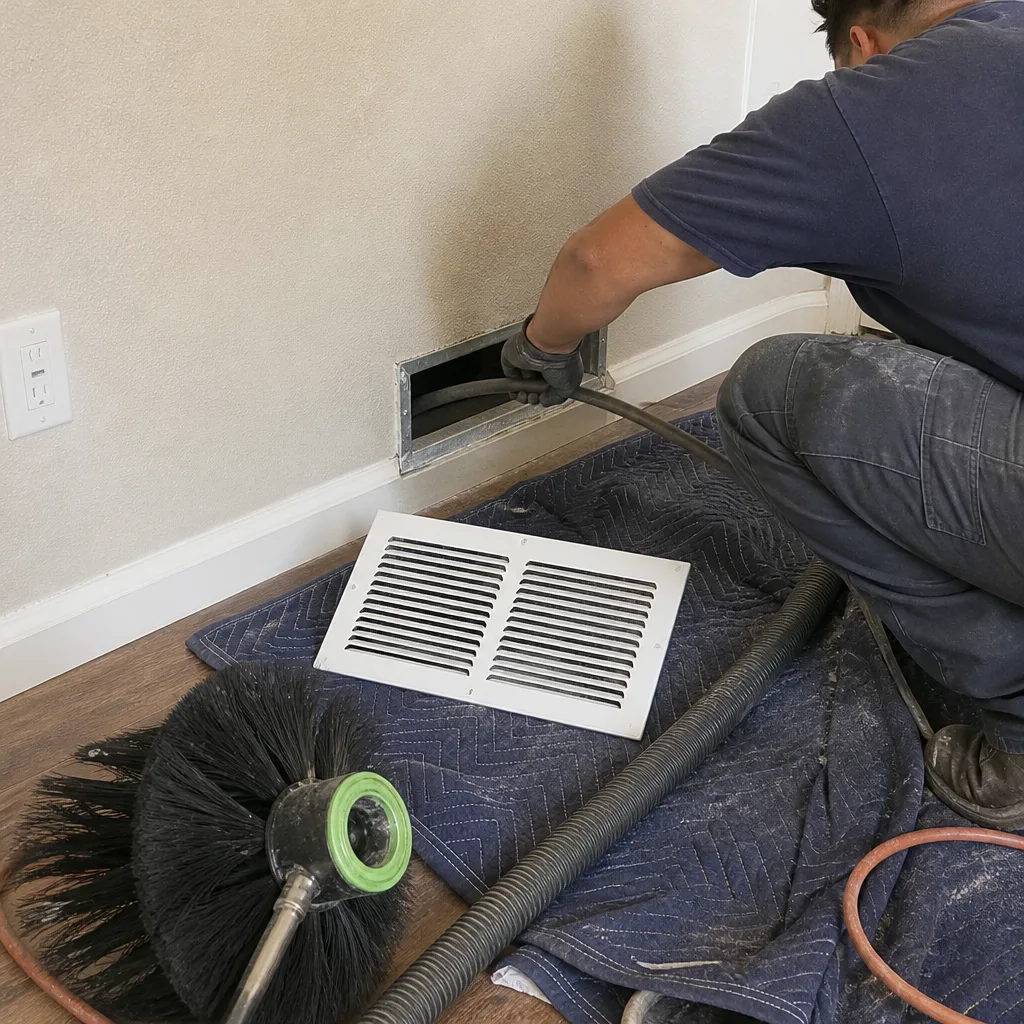
The difference between a discount duct cleaner and Cornerstone Duct Cleaning home service approach comes down to the equipment on the truck and what it does to the inside of the duct. The relevant distinction is agitation. A suction-only method, which is what most discount operators use, attaches a large vacuum to one register and pulls air through the system. That removes loose debris near the vacuum point and leaves everything adhered to the duct walls in place. Dust, pet dander, construction debris, and smoke particulate that has bonded to the duct lining or to the accumulated film on the interior surface do not move with suction alone. They need mechanical agitation.
That is what a Rotobrush rotary-brush system provides. The rotating brush head contacts the interior surface of the duct and physically dislodges the adhered material, which is then captured by the vacuum. The brush does the work that airflow alone cannot. This is the same principle used across professional HVAC and duct-cleaning industries, and it is the difference between cleaning the air and cleaning the surface the air moves across. In a post-emergency scenario, especially after wildfire smoke, the particulate is fine, sticky, and chemically active. Agitation matters more after a smoke event than in ordinary conditions.
The second piece is containment. Professional remediation work, the kind done after floods and fires, uses air filtration devices built to HEPA standards. That is the role Nikro equipment and Abatement Technologies filtration gear play. In a professional cleaning application, the filtration gear captures the material being removed from the ducts so it does not re-enter the living space. A discount operator with a shop vacuum and a brush does not have this capability. The particulate they dislodge goes into the air in the house, and a meaningful portion settles back into the ducts within days. We use Nikro and Abatement Technologies equipment on every job because the air quality during the cleaning matters as much as the air quality after it.
The third piece is system knowledge. Duct cleaning is not an isolated task. It interacts with the filter, the coil, the blower, the plenum, the boots, and the connected appliances. Understanding how a Honeywell thermostat drives an Aprilaire media filter on a system with a rooftop AC package unit is not esoteric knowledge; it is the difference between cleaning a duct and cleaning the full air pathway. Dryer vent cleaning in Chula Vista is a related but distinct service with its own safety and performance considerations, and the cleaner who understands one system deeply is usually better at the other. The full air pathway is a connected system, and the emergency protocols in this guide assume a contractor who understands the whole thing, not just the ducts.
Common Mistakes to Avoid
- Running the HVAC system after a smoke event without a coil inspection. The filter does not catch smoke particulate. Running the system pushes settled particulate off the coil and into the house. A filter swap alone addresses the wrong component.
- Waiting more than 48 hours to address wet ductwork after a flood. Mold germination starts within 48 to 72 hours on wet organic material. Duct insulation and accumulated duct dust are both organic. By the time you can smell it, established growth has occurred, and cleaning may not be enough to solve the problem.
- Assuming a visible inspection from the registers is sufficient after an earthquake. Register-level visual checks cannot see a separated connection at the plenum or a crushed flex duct run in the middle of the attic. The damage that matters often requires getting into the attic or crawlspace to find.
- Continuing to run the system during an active air quality emergency with a standard filter. A one-inch fiberglass filter does not stop smoke particulate. Running the system on recirculate with an inadequate filter just distributes the particulate more evenly.
- Hiring a cleaning company that does not offer repair as a parallel service. If the cleaning technician finds a disconnected duct, a water-damaged section, or a crushed flex run, and the company does not do repairs, you will be calling someone else. The inspection was the point, and it did not get fixed.
- Vacuuming or sweeping during a smoke event to keep the house clean. Household vacuuming without a HEPA-sealed unit releases fine particulate into the room air, which then gets pulled into the return and deposited in the duct system. Clean after the event, not during it.
- Scheduling a duct cleaning before replacing a loaded filter. The filter is upstream of the blower. A cleaning performed while a smoke-loaded or dust-loaded filter is still in place means the system is pulling through the restriction while the brush and vacuum work. Replace the filter first, then clean the system.
When to Call a Professional
Some situations are beyond a homeowner’s ability to resolve with a flashlight and a filter change. If you can see soot streaking on registers after a smoke event, call a professional for a coil and duct inspection. If your crawlspace flooded and the ducts run through it, call before you run the system again. If you have felt an earthquake and airflow has changed in any room, the system needs a real inspection, not a duct-cleaning special. If anyone in the house has a respiratory condition and the registers smell different after an event, that is an immediate call. Cornerstone Duct Cleaning offers free estimates in Chula Vista at (877) 824-2920. We bring the full air pathway approach: cleaning, venting, and repair from one crew, with equipment built for remediation, not just appearance.
Frequently Asked Questions
Wait until the air quality index returns to moderate or good, then schedule an inspection. Running a full cleaning during an active smoke event is counterproductive; the cleaning process itself moves air, and you do not want to pull more outdoor particulate into the system. The ideal window is within two to four weeks after the event, once the outdoor air has cleared and the system has been shut off or run minimally. The longer you wait, the more the settled particulate bonds to the coil and duct surfaces. For an exact timeline for your home, call (877) 824-2920.
Yes. Smoke particulate from wildfire events in the Chula Vista area is fine enough to pass through standard filters and settle in the duct system. It can remain on the coil, on the interior duct surfaces, and in the blower cabinet for months. Every time the system runs, a portion of that particulate re-enters the air stream, which is why the smoky smell lingers in some homes long after the outdoor air has cleared. A coil and duct inspection is the only way to confirm the extent of the contamination.
Check the register airflow first. Turn the system on for one minute and walk each room, feeling for airflow changes. A room with suddenly weak flow or a room with noticeably stronger flow suggests a separated or crushed duct somewhere in the branch network. Then check the flex duct connections at the plenum and boots in the attic or crawlspace. These connections are the weakest points in a residential system and the most likely to fail under shaking. Call (877) 824-2920 if you find anything out of place.
Yes. Standing water in a crawlspace raises the humidity in that enclosed space dramatically. Fiberglass duct insulation absorbs moisture from the air even without direct water contact, and once the insulation is damp, the duct interior becomes humid enough to support mold growth on accumulated dust and debris. The duct does not need to be sitting in the water to be compromised. If your crawlspace held water and your ducts run through it, treat it as a water exposure event.
Mold can establish in wet duct insulation and on wet accumulated debris within 48 to 72 hours under typical Chula Vista temperature conditions. The clock starts when the moisture contacts the material. This timeline is why water-damaged flex duct sections are typically replaced rather than cleaned. Cleaning removes surface material but cannot restore water-damaged fiberglass insulation to its original condition.
The primary difference is agitation and containment. A discount cleaning typically uses suction only, which leaves adhered material on the duct walls. A contractor-grade cleaning uses mechanical agitation, such as a Rotobrush rotary-brush system, to dislodge the adhered material, and HEPA-level filtration equipment from brands like Nikro and Abatement Technologies to contain the removed particulate. The second difference is scope. A contractor-grade provider can also identify and repair separated ducts, crushed flex runs, and failed connections during the same visit. The cleaning reveals the problem; the repair fixes it.
The Bottom Line
Chula Vista’s air system emergencies are predictable. Wildfire smoke comes with fire season. Flooding comes with winter storms. Earthquakes come without warning. In each case, the sequence of correct action is the same: shut the system down, inspect before running, understand what entered the ducts, and call for professional assessment when the problem is beyond a filter change. The filter protects the equipment. The duct cleaning, coil inspection, and repair protect the people. For Chula Vista homeowners, the right preparation is simple: know where your shutoff is, keep your filters current, document your duct configuration, and have a contractor-grade company in mind before the smoke rolls in or the ground shakes. Built on the right foundation, your air system handles the next event. Neglected, it makes the event worse.
Written by the team at Cornerstone Duct Cleaning, serving Chula Vista since 2013.
See the difference
 Before
 After
 Before
 After
 Before
 After